
When you’re planning a new website for your business, one question often comes up early: Should you build a static website or a dynamic website?
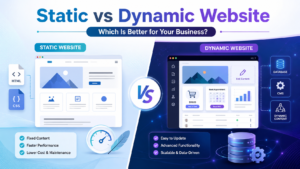 Both options can give your business a strong and professional online presence, but they work in very different ways.
For example, a small business that only wants to display its services, contact details and a few company photos may not need the same type of website as an ecommerce store, real estate portal or travel company that updates information regularly.
That’s why understanding the difference between a static vs dynamic website is important before you start development.
Choosing the right option can save you unnecessary costs today and make sure your website can support your business as it grows.
In this guide, we’ll explain static and dynamic websites in simple terms, look at their advantages and limitations, and help you understand which one may be better for your business.
What Is a Static Website?
A static website is a website where most of the content stays the same unless someone manually changes it.
In simple words, what visitors see on the website is usually already created and stored on the server.
Static websites are commonly built using technologies such as:
- HTML
- CSS
- JavaScript
Imagine a small company website with only a Home page, About Us page, Services page and Contact page.
If the information on these pages doesn’t need to change frequently, a static website can handle the job perfectly well.
Whenever someone visits the website, the server simply sends the already-created page to their browser.
Because there is usually less processing happening in the background, static websites can be lightweight, simple and very fast when developed properly.
Where Are Static Websites Commonly Used?
 Static websites are often suitable for:
- Small business websites
- Portfolio websites
- Personal websites
- Company introduction websites
- Landing pages
- Event websites
- Product showcase websites
- Informational websites
If your website mainly provides information and you don’t expect to update it regularly, a static website may be all you need.
What Is a Dynamic Website?
A dynamic website is designed to handle content that changes regularly.
The information displayed on the website may change depending on what a user does, what is stored in a database or what the website administrator updates.
Dynamic websites often use technologies and platforms such as:
- PHP
- Laravel
- WordPress
- JavaScript frameworks
- Node.js
- MySQL and other databases
Think about an ecommerce website.
The website may need to display hundreds of products, changing prices, stock availability, customer accounts, order details and payment information.
Creating every page manually would be extremely difficult.
Instead, the website pulls the required information from a database and displays it whenever the user needs it.
A real estate website works in a similar way.
Properties can be added, edited or removed through an admin panel without creating each property page manually.
This flexibility makes dynamic websites especially useful for businesses that frequently update or manage large amounts of information.
Where Are Dynamic Websites Commonly Used?
Dynamic websites are commonly used for:
- Ecommerce stores
- News websites
- Blogs
- Real estate portals
- Travel websites
- Educational portals
- Healthcare websites
- Membership websites
- Booking platforms
- Online directories
- Customer portals
- Web applications
Static vs Dynamic Website: What Is the Main Difference?
The main difference between a static vs dynamic website comes down to how the website manages and displays information.
A static website usually shows content that has already been created.
A dynamic website can retrieve or update information depending on databases, user activity or a content management system.
Here’s a simple comparison:
| Feature | Static Website | Dynamic Website |
|---|---|---|
| Content | Mostly fixed | Can change regularly |
| Database | Usually not required | Commonly used |
| Content Updates | Often need technical editing | Usually managed through an admin panel |
| Development | Simpler | More advanced |
| Features | More limited | Highly flexible |
| User Accounts | Rarely required | Can be added |
| Ecommerce | Limited | Well suited |
| Blog Management | More difficult | Easy with a CMS |
| Scalability | Good for smaller websites | Better for expanding websites |
| Maintenance | Usually simpler | Requires regular maintenance |
One option isn’t automatically better than the other.
The right choice depends entirely on what you want your website to do.
Advantages of a Static Website
Static websites are still a very practical choice for many businesses.
Faster Loading
Static pages can often load very quickly because the server does not need to repeatedly collect information from a database before displaying the page.
A faster website creates a smoother experience for visitors and helps them find the information they need without unnecessary waiting.
Simpler Development
Static websites generally involve fewer complex features.
If you only need a small website with a few pages, development can be much more straightforward.
Ideal for Simple Business Requirements
Sometimes businesses simply need a professional online presence.
If your website only needs to explain who you are, what services you provide and how customers can contact you, there may be no reason to build a complicated backend system.
Fewer Components to Maintain
A basic static website may not depend on large databases, plugins or content management systems.
That means there are usually fewer technical components that need regular updates or maintenance.
Limitations of a Static Website
Static websites are useful, but they aren’t suitable for every situation.
Updating Content Can Be Difficult
If you want to change text, add new images or create additional pages, you may need someone with website development knowledge.
This can become inconvenient if your business needs frequent updates.
Limited Advanced Features
Features such as customer accounts, online bookings, product management, dashboards and personalised content usually require a more advanced website structure.
Managing Large Websites Becomes Difficult
A website with hundreds of manually created pages can quickly become difficult to manage.
If you expect your website to grow significantly in the future, it’s worth thinking ahead before choosing a completely static setup.
Advantages of a Dynamic Website
Dynamic websites offer much more flexibility, especially for businesses that regularly update their websites or need interactive features.
Easier Content Management
Many dynamic websites come with a content management system, commonly known as a CMS.
For example, WordPress allows authorised users to update pages, upload images and publish blogs without directly editing the website code.
This can make day-to-day website management much easier.
Supports Advanced Business Features
Dynamic websites can support features such as:
- Login systems
- Booking forms
- Product management
- Payment gateways
- Search filters
- Customer dashboards
- Membership areas
- Online enquiry systems
- User profiles
- Database-driven content
This makes them suitable for businesses that need more than a simple informational website.
Better for Growing Businesses
As your business grows, you may want to add new services, products, categories, locations or articles.
With a well-built dynamic website, these additions can usually be made without rebuilding the entire website.
More Personalised User Experiences
Dynamic websites can also display different information depending on the visitor.
For example, an ecommerce website may show a logged-in customer their previous orders, account details or recommended products.
Limitations of a Dynamic Website
Dynamic websites provide more flexibility, but they also come with additional responsibilities.
More Development Work
Databases, admin panels and advanced features usually require more development than a simple static website.
The exact amount of work depends on what functionality your business needs.
Regular Maintenance Is Important
Dynamic websites may require ongoing attention such as:
- Software updates
- Plugin updates
- Database maintenance
- Security monitoring
- Website backups
- Performance optimisation
Regular maintenance helps keep the website secure, stable and working properly.
Poor Development Can Affect Website Speed
A dynamic website does not automatically mean a slow website.
However, unnecessary plugins, oversized images, heavy scripts, poor coding and weak hosting can reduce performance.
That’s why proper development and optimisation are important.
Which Website Is Better for a Small Business?
For a small business with basic requirements, a static website may be more than enough.
For example, you may only need to show:
- Company information
- Services
- Contact details
- A few photographs
- An enquiry form
In this situation, keeping the website simple can make sense.
However, being a small business doesn’t automatically mean you should choose a static website.
A dynamic website may be more useful if you want to:
- Publish blogs regularly
- Update services yourself
- Add new offers
- Manage testimonials
- Create new pages
- Publish SEO content
- Expand the website over time
So instead of choosing based only on the size of your company, think about what you actually want the website to achieve.
Your goals matter more than your business size.
Static vs Dynamic Website for SEO
Both static and dynamic websites can perform well in search engines when they are developed correctly.
Google and other search engines care about many factors, including:
- Helpful and relevant content
- Website loading speed
- Mobile friendliness
- Proper page structure
- Correct heading usage
- Meta titles and descriptions
- Internal linking
- Image alt text
- User experience
- Crawlability
Static websites can perform very well because they can be lightweight and fast.
Dynamic websites can also perform strongly, especially because they make it much easier to regularly publish new blogs, service pages and other useful content.
If SEO is going to be a long-term part of your marketing strategy, a properly developed dynamic website can make ongoing content management easier.
Static vs Dynamic Website for Ecommerce
If you’re planning to sell products online, a dynamic website is generally the more practical option.
An ecommerce website may need to manage:
- Products
- Prices
- Inventory
- Customer information
- Orders
- Payments
- Coupons
- Shipping information
- Customer accounts
All of this information changes regularly.
That’s why ecommerce platforms usually rely on databases and dynamic functionality.
A static website can still be useful if you only want to showcase a few products without selling them online, but it is generally not suitable for managing a complete ecommerce operation.
Static vs Dynamic Website: Which One Costs More?
Website cost depends on what you actually need rather than simply whether the website is static or dynamic.
A small static website will normally cost less to develop than a large custom dynamic platform because less development work is involved.
However, several factors can affect the final cost, including:
- Number of pages
- Website design requirements
- Custom features
- Admin panel
- Ecommerce functionality
- Payment gateway integration
- Third-party integrations
- Content requirements
- SEO setup
- Ongoing maintenance
Instead of choosing the cheapest option, think about what will be useful for your business over the next few years.
A cheaper website that needs to be completely rebuilt later may not always be the most economical choice.
How to Choose the Right Website for Your Business
Before deciding between a static website vs dynamic website, ask yourself a few practical questions.
How Often Will You Update the Website?
If your content is unlikely to change very often, a static website may be enough.
If you plan to regularly publish blogs, offers, products, services or other updates, a dynamic website will usually be easier to manage.
Do You Need an Admin Panel?
Think about who will manage the website.
If you want your team to update content without depending on a developer every time, a dynamic website with an admin panel or CMS may be the better choice.
Do You Need Advanced Features?
Do you need bookings, payments, customer accounts, dashboards or login functionality?
If yes, you’ll probably need dynamic development.
Do You Plan to Expand in the Future?
Don’t think only about what your business needs today.
Consider where your website might be in two or three years.
Your website should ideally support your growth instead of forcing you to start again whenever your requirements change.
Why Professional Website Development Matters
Whether you choose a static or dynamic website, the quality of development matters more than the label.
A professional business website should be:
- Mobile responsive
- Easy to navigate
- Fast loading
- Secure
- Visually consistent
- SEO-friendly
- Easy for customers to contact you through
- Built around your actual business goals
A good Website Development Company should first understand what your business needs.
Only then should they recommend the right platform, technology and website structure.
There is no reason to sell every business the exact same website solution.
Why Choose SK Digital Solution for Website Development?
At SK Digital Solution, we develop websites around the actual needs of each business.
Instead of focusing only on how a website looks, we also consider how customers will use it, how easily your team can manage it and how well it can support your future marketing and growth.
Our website development services include:
- Static websites
- Dynamic websites
- WordPress websites
- Ecommerce websites
- Custom website development
- Business websites
- Responsive web design
- Landing pages
- Website redesign
- Website maintenance
- SEO-friendly website development
- Website speed optimisation
The goal is simple: to build a website that works for your business today while giving you enough flexibility for tomorrow.
Frequently Asked Questions
What Is the Difference Between a Static and Dynamic Website?
A static website generally displays fixed content that needs to be manually updated.
A dynamic website can display or update information using databases, content management systems and user interactions.
Is a Static Website Good for Business?
Yes.
A static website can be an excellent choice for a business that only needs a simple website and does not plan to update its content regularly.
Is a Dynamic Website Better for SEO?
Not necessarily.
Both static and dynamic websites can rank well when they follow good SEO practices.
However, dynamic websites often make it easier to regularly publish blogs, service pages and updated content.
Is WordPress a Static or Dynamic Website?
WordPress is mainly a dynamic content management system.
Website content is usually stored in a database and displayed when someone visits the page.
Which Website Is Better for Ecommerce?
A dynamic website is normally the better choice for ecommerce.
Online stores need to regularly manage products, pricing, inventory, payments, customer accounts and orders.
Can a Static Website Be Converted Into a Dynamic Website?
Yes.
If your business grows and you later need features such as a CMS, ecommerce functionality or an admin panel, a static website can be redesigned or migrated to a dynamic platform.
Static or Dynamic: Which Website Should You Choose?
There is no universal winner in the static vs dynamic website debate.
The better option is the one that matches your business requirements.
Choose a static website if you need a simple, fast and mainly informational website with very few updates.
Choose a dynamic website if you expect to regularly update content, sell products, accept bookings, create user accounts, manage dashboards or expand your website in the future.
Most importantly, don’t choose technology simply because it is popular.
Choose the solution that makes your website easier for customers to use and easier for your business to manage.
Not sure whether your business needs a static or dynamic website? Contact SK Digital Solution to discuss your requirements and choose a website solution that supports both your current needs and future growth.